


Journal · Facial Sculpting
Why Your Face Looks Asymmetrical in Photos but Not in the Mirror
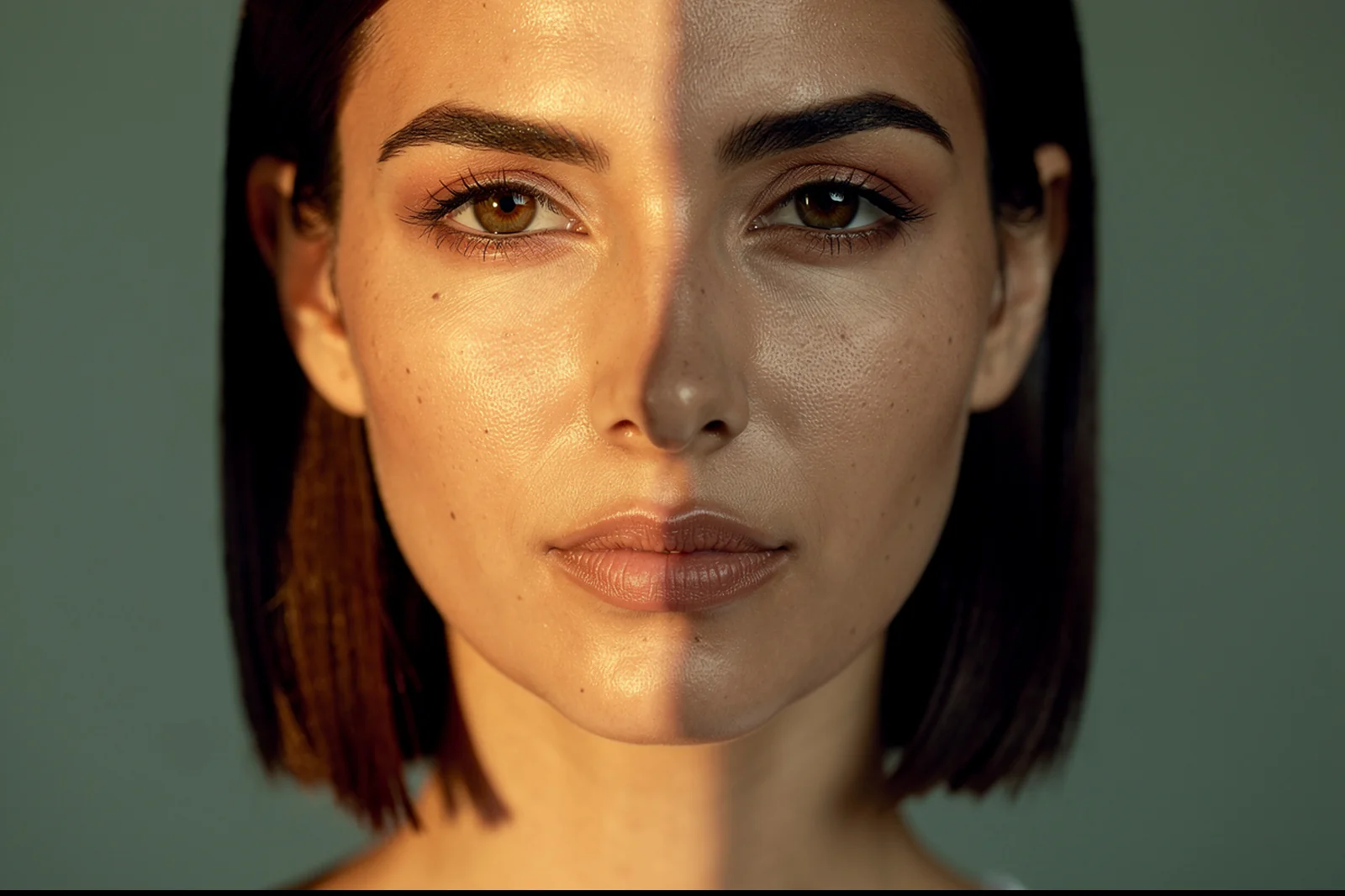
If your face looks noticeably uneven in photographs but perfectly fine in the mirror, the most likely explanation is that the mirror has been lying to you kindly for years. A mirror shows a left-right reversed image, and that reversed version is the face you have grown up with. A camera shows the unreversed face everyone else sees, then adds lens distance, a single frozen expression and whatever the lighting is doing. The asymmetry is usually real, but the photograph is not a neutral witness.
This is one of the most common things people bring to a consultation at Facial Sculpting in South Kensington, London, often with a photo already open on their phone. Dr Nina Bal's answer is rarely the one people expect, because the useful question is not "how uneven am I" but "how much of what I am seeing is my face, and how much is the picture". This guide separates the two. It is general information rather than personal advice.
Key takeaways
- A mirror shows a reversed face, and familiarity with that reversed version is why photos feel unfamiliar.
- Close-range phone photography enlarges whatever is nearest the lens, which exaggerates real differences.
- Side lighting and a single frozen expression both make normal asymmetry look far more pronounced.
- Virtually every face is asymmetrical; the relevant test is whether people notice it in real life.
- Sudden asymmetry is a medical question, not a cosmetic one, and needs urgent assessment.
Why does my face look asymmetrical in photos?
Your face looks asymmetrical in photographs because a photo reverses the version you know, magnifies whatever is closest to the lens, and captures one moment of a moving face under lighting you did not choose. Real asymmetry is then read against an unfamiliar reference, so a difference you have never noticed suddenly looks like the only thing in the frame.
Each of those factors is separable, and understanding which one is driving what you see decides whether the answer is a better photograph, a change in habit, or a clinical assessment. In practice, most people who arrive convinced they have a problem are looking at a real but modest difference amplified by two or three photographic effects stacked on top of each other.
Almost every face is asymmetrical. The question worth answering is not whether yours is, but whether the difference is noticeable to anyone who is not studying a photograph of it.
The mirror shows you a reversed face
The mirror image is flipped: your left cheek appears on the right of the reflection. Because you check that reflection every day, that flipped arrangement is the version your brain treats as normal. A photograph presents the true orientation, so a slightly higher brow or a fuller cheek moves to the opposite side of the image and reads as unfamiliar rather than as a small variation.
Psychologists have studied this directly. Research on reversed facial images and the mere-exposure effect, most famously work published by Mita, Dermer and Knight in 1977, found that people tended to prefer the mirror-reversed images of themselves while their close friends preferred the true, unreversed images. Both groups preferred the version they were used to seeing. That is worth holding on to: the photograph is not showing you a worse face, it is showing you a less familiar one.
What the camera does that a mirror does not
Beyond reversal, four things routinely change how symmetrical a face looks in a photograph. None of them are your face.
| What changes | What it does to your face | What helps |
|---|---|---|
| Camera distance | At arm's length, features nearer the lens (usually the nose and the cheek turned towards it) render proportionally larger, so the two sides stop matching. | Have someone photograph you from a metre and a half or more, and zoom in rather than stepping closer. |
| Head angle and tilt | A few degrees of rotation or tilt shortens one side of the face and lengthens the other. Most people habitually turn to their preferred side. | Camera at your own eye level, chin level, shoulders square to the lens. |
| Lighting direction | Light from one side or from overhead throws shadow under one cheek, brow or jaw and not the other, inventing contour differences. | Even, front-facing daylight, ideally near a window with no direct sun. |
| One frozen moment | Faces are asymmetrical in movement. A photo can freeze a half-formed smile or a raised brow that lasted a fraction of a second. | Take three or four frames and judge the set, not the single worst one. |
There is a fifth, quieter one. Depending on your phone and its settings, the front camera may show you a mirrored preview and then save the unmirrored file, or save exactly what you saw. If your selfies look different from the moment you took them, that setting is usually why, and it is worth checking before drawing conclusions about your face.

Is my face actually asymmetrical?
Yes, and so is everybody else's. Perfect bilateral symmetry does not occur in human faces, and manufactured symmetry, the kind produced by mirroring one half of a photograph, tends to look uncanny rather than attractive. Minor asymmetry is part of what makes a face look like a person rather than a rendering.
What differs is the degree, and the usual sources are familiar ones: one brow sitting higher, a flatter or fuller cheek on one side, a smile that pulls further one way, a chin that sits slightly off centre, or uneven jaw definition that shows most in profile. Some of this is developmental and has been there since childhood. Some accumulates, because habitual expressions, chewing on a preferred side, sleeping position and the ordinary volume changes of ageing do not affect both sides equally.
A practical test is worth more than any measurement. Ask whether anyone has ever mentioned it, whether you notice it on other people's faces at conversational distance, and whether it is visible in a well-lit photograph taken from a normal distance rather than only in close phone shots. If the answer is no on all three, you are almost certainly looking at a photographic artefact sitting on top of the normal human variation.
A considered next step
Want to know whether what you are seeing is treatable, or simply normal?
A consultation with Dr Nina starts by reading your face at rest and in movement, in person rather than in a photograph. If the right answer is that nothing needs treating, that is what you will hear.
How do I take a photograph that shows my face accurately?
If you want a fair reference, whether for your own reassurance or to bring to a consultation, the conditions matter more than the camera. This is the sequence we suggest.
- Stand facing a window, in daylight, with no direct sun on your face and no lamp or ceiling light adding a second shadow.
- Have someone else hold the camera, at your eye level, from at least a metre and a half away. Use the rear camera and zoom in rather than moving closer.
- Square your shoulders and level your chin, then look straight down the lens with a neutral, relaxed expression.
- Take three frames: neutral, a natural smile, and one in profile. Movement asymmetry only shows across a set.
- Check your mirroring setting before you compare anything, so you know whether you are looking at the reversed or the true orientation.
Photographs taken this way are also what a clinic can actually use. Assessment photography at Facial Sculpting follows the same logic, standardised distance, angle and lighting, so that any change is judged against your own face under matched conditions rather than against a flattering shot.
When is facial asymmetry worth a clinical assessment?
When it is visible to you and to others under ordinary conditions, has been there long enough to be stable, and bothers you enough to want an answer. At that point the useful question is what is driving it, because the cause decides whether anything can sensibly be done.
- Soft tissue and volume. Uneven fat pads or one side losing volume faster can leave a cheek, brow or lip line sitting differently. This is the most treatable category, and it is where a considered face shape sculpting or chin sculpting plan can genuinely help.
- Muscle and movement. Habitual expression and uneven muscle pull can raise one brow or drag a smile to one side. Carefully dosed, side-specific botulinum toxin in a brow lift can rebalance minor differences of this kind.
- Skeletal and dental. Differences in the underlying bone, jaw position or bite are structural. Filler placed over a skeletal asymmetry rarely resolves it and can make the face look heavier rather than more balanced. A surgical or dental opinion is the appropriate route.
- Skin laxity. Loose or lax skin does not always sag evenly, so one side of the jawline or cheek can look softer than the other in photographs. Structural skin-tightening treatments such as XERF are designed for that general firmness rather than one specific feature.
Sorting a face into those categories is the entire job of the first appointment. Dr Nina's asymmetrical face protocol is an assessment and a bespoke plan rather than a single procedure, and the closely related Golden Ratio analysis is used where the concern is overall proportion rather than one uneven feature. The wider picture, including which differences are worth leaving alone, is set out on our facial asymmetry concern page, and profile-driven imbalance is covered under side profile and chin projection.
The limit is worth stating plainly. Treatment aims to soften a noticeable difference, not to deliver a mirror-image face, and there are faces where the right recommendation is no treatment at all. That is the same facial balancing logic applied to one specific question: change the relationship that is pulling the face out of proportion, protect everything that is already working.
When asymmetry needs a doctor rather than an aesthetic clinic
There is one situation where none of the above applies. Asymmetry that appears suddenly is a medical matter and needs urgent attention, not a cosmetic consultation. Seek emergency help by calling 999 in the UK if one side of the face droops or your smile changes abruptly, particularly alongside weakness or numbness in an arm, difficulty speaking, confusion or a change in vision. Sudden facial weakness can also occur in Bell's palsy, which is not an emergency in the same way but should still be assessed by a doctor promptly, because early treatment matters. Once the diagnosis is established and the acute phase has passed, residual facial asymmetry after Bell's palsy is something the clinic does treat, working alongside your medical team rather than instead of it.
New asymmetry that develops over weeks or months, or that comes with pain, swelling, hearing changes or difficulty chewing, also belongs with your GP first. Facial Sculpting does treat some medically driven facial asymmetry, but only after the underlying cause has been established by the right specialist.
Most common cause
A real but modest asymmetry, amplified by mirror reversal, close-range photography and side lighting.
What is realistic
Softening a genuinely noticeable soft-tissue or muscle difference. Never a perfectly symmetrical face.
When to seek help urgently
Any sudden facial droop, weakness, speech or vision change. Call 999 in the UK.
If you have been studying the same photograph for weeks, an in-person assessment will tell you more in twenty minutes than the photo ever will. Book a consultation at our South Kensington clinic or message us on WhatsApp, and you will get an assessment of your face as it actually is, and a straight answer about whether anything is worth treating.
Common questions
Your questions, answered
-
Almost certainly both. Every face is asymmetrical to some degree, so there is always a real difference to find. The camera then exaggerates it, because a photo un-reverses the face you know from the mirror, freezes one moment of expression and adds lens and lighting effects the mirror does not have. The reliable test is whether other people notice the difference in real life, not whether a photo shows it.
-
The mirror shows you a left-right reversed version of your face, and it is the version you have seen every day of your life. Familiarity makes an image feel more comfortable to look at, an effect psychologists have studied as the mere-exposure effect. A photograph shows the unreversed face other people see, so any asymmetry lands on the side you are not used to and reads as new.
-
It can, mostly through distance rather than the lens itself. Holding a phone at arm's length puts the camera very close to your face, so features nearer the lens, typically the nose and the cheek turned towards it, are rendered proportionally larger than they look from normal conversational distance. Stepping back and zooming in, or having someone photograph you from a few steps away, reduces the effect considerably.
-
Use even, front-facing daylight rather than overhead or side lighting, keep the camera at your own eye level, have someone take the picture from at least a metre and a half away, use the rear camera, and check whether your phone is saving a mirrored image. Take two or three so you are not judging a single frozen expression.
-
Any asymmetry that appears suddenly, or that comes with drooping on one side of the face, a change in your smile, weakness, numbness, difficulty speaking or a change in vision, needs urgent medical assessment rather than an aesthetic consultation. In the UK that means calling 999 if it comes on suddenly. Gradual, long-standing asymmetry is not an emergency, and can be assessed in a routine consultation.
-
No, and a clinic that promises it is promising the wrong thing. Perfect symmetry does not occur in nature and tends to look unsettling when it is manufactured. What careful treatment, planned from a full facial assessment, can do is soften a difference that is genuinely noticeable, where that difference is driven by soft tissue or muscle. Asymmetry that comes from the underlying bone, the bite or a nerve condition sits outside non-surgical aesthetics.
Keep reading
Related reading
What Is Facial Balancing? A Guide to Harmonising Your Features
What facial balancing actually means, how a proper assessment works, which treatments are used and when each is wrong, explained by Dr Nina Bal in London.
Read more
Jawline Contouring vs Chin Enhancement: Which Treatment Is Right for You?
When it comes to enhancing your natural beauty, we think less is more. We don’t want to change your face; we just want to help boost your confidence with small, precise treatments designed to make you feel more beautiful
Read more
The ‘Refresh Not Replace’ Philosophy: Why Less Is More in Aesthetic Medicine
In a world saturated with transforming makeovers, at Facial Sculpting, Dr. Nina champions a more refined, confident approach to ageing. Grounded in the ‘Refresh Not Replace’ philosophy, we prioritise natural enhancements
Read more