


"If I could leave more than five stars I would! Dr Nina’s clinic is warm and welcoming, in a beautiful location close to Knightsbridge station. I had cheek fillers for the first time and my face was numbed prior. I was expecting to find it a little uncomfortable but honestly there was barely any pain at all. The needles are so fine, and Dr Nina was very gentle. I will be back as I know I am in good hands!"

Treatments · Facial Sculpting
Cheek Fillers
A minimally invasive hyaluronic-acid dermal filler treatment that restores lost volume to the midface and refines the cheekbones, performed at Facial Sculpting, Dr Nina Bal’s South Kensington clinic, for a softly lifted, balanced look that still moves and ages like your own face.
- Treatment
- Hyaluronic-acid dermal filler · midface
- Best for
- Volume loss, flat cheeks, cheekbone definition
- Downtime
- Minimal, back to normal the same day
- Results
- Immediate · settle over ~2 weeks
- Longevity
- Typically ~12 to 18 months for the cheeks
- From
- £635, consultation first
★★★★★ 5.0 on Google
Save Face Platinum accredited
As seen in


Treatment summary
Cheek filler at a glance
Cheek filler is a non-surgical treatment that uses cross-linked hyaluronic-acid (HA) dermal filler to replace volume lost in the midface and to lend gentle definition to the cheekbones. It is designed to restore, lift and balance, not to inflate, and is fully reversible with hyalase if ever needed. Results vary from person to person.
- What it treats
- Midface volume loss, flat or hollow cheeks, soft cheekbone definition
- How it works
- HA filler placed in the midface to restore volume & support the overlying skin
- Areas
- Cheek apple, cheekbone (zygoma) and the upper midface
- Anaesthetic
- Topical numbing if needed; most fillers contain local anaesthetic
- Sessions
- Often one session per area; a top-up may refine the result
- Downtime
- Minimal; swelling and the odd bruise can occur
- Results & longevity
- Immediate; settle by ~2 weeks; typically last ~12 to 18 months
- Reversible
- Yes, HA filler can be dissolved with hyalase
- Performed by
- Dr Nina Bal & the Facial Sculpting team
- Price
- From £635, confirmed at consultation
The treatment
What are cheek fillers?
Cheek fillers are a non-surgical option for patients who want to add lost volume and improve definition in the midface without surgery. At Facial Sculpting we use injectable, cross-linked hyaluronic-acid (HA) dermal filler placed in carefully chosen points across the cheek and cheekbone. HA is a sugar molecule the body produces naturally; the filler draws in a little water and gives soft-tissue support, restoring volume and lending a more lifted, contoured look to the upper face.
As we age, the fat pads of the midface flatten and descend and the underlying bone changes, so the cheeks lose projection and the face can look tired or slightly hollow. Replacing that volume in the right place does more than fill, it can subtly support the skin above the nasolabial area and rebalance the relationship between the upper and lower face. Dr Nina’s approach is deliberately less is more: enough to refresh and define, never so much that the face looks over-filled or unnatural.
Cheek filler is one of several ways to add midface structure, see how it sits alongside our wider facial sculpting treatments, the bespoke Golden Ratio assessment and full-face face shape sculpting, and where the midface has softened rather than lost volume, XERF multifrequency radiofrequency skin tightening is the needle-free route to firmness, and read the limitations set out below.
Real results
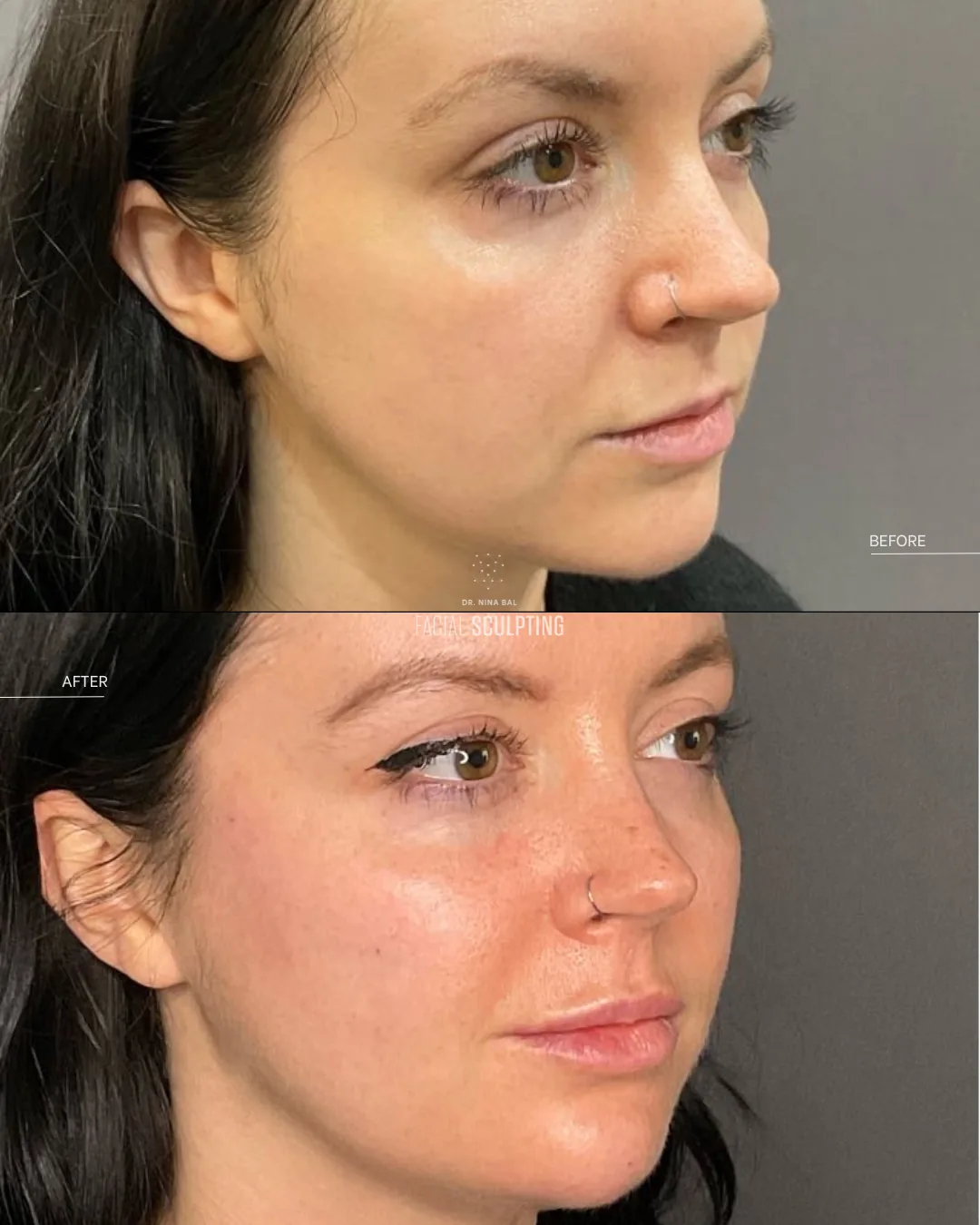
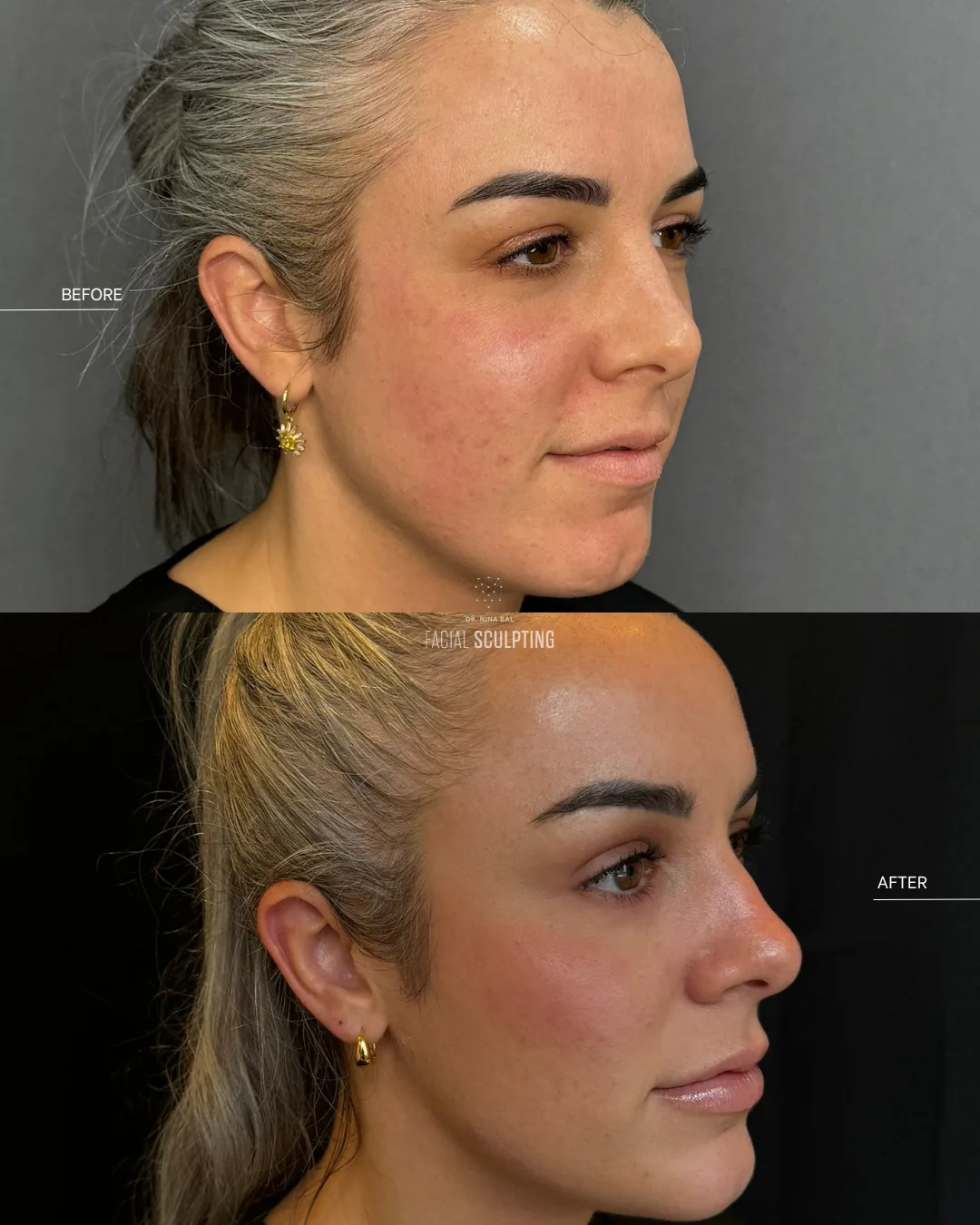
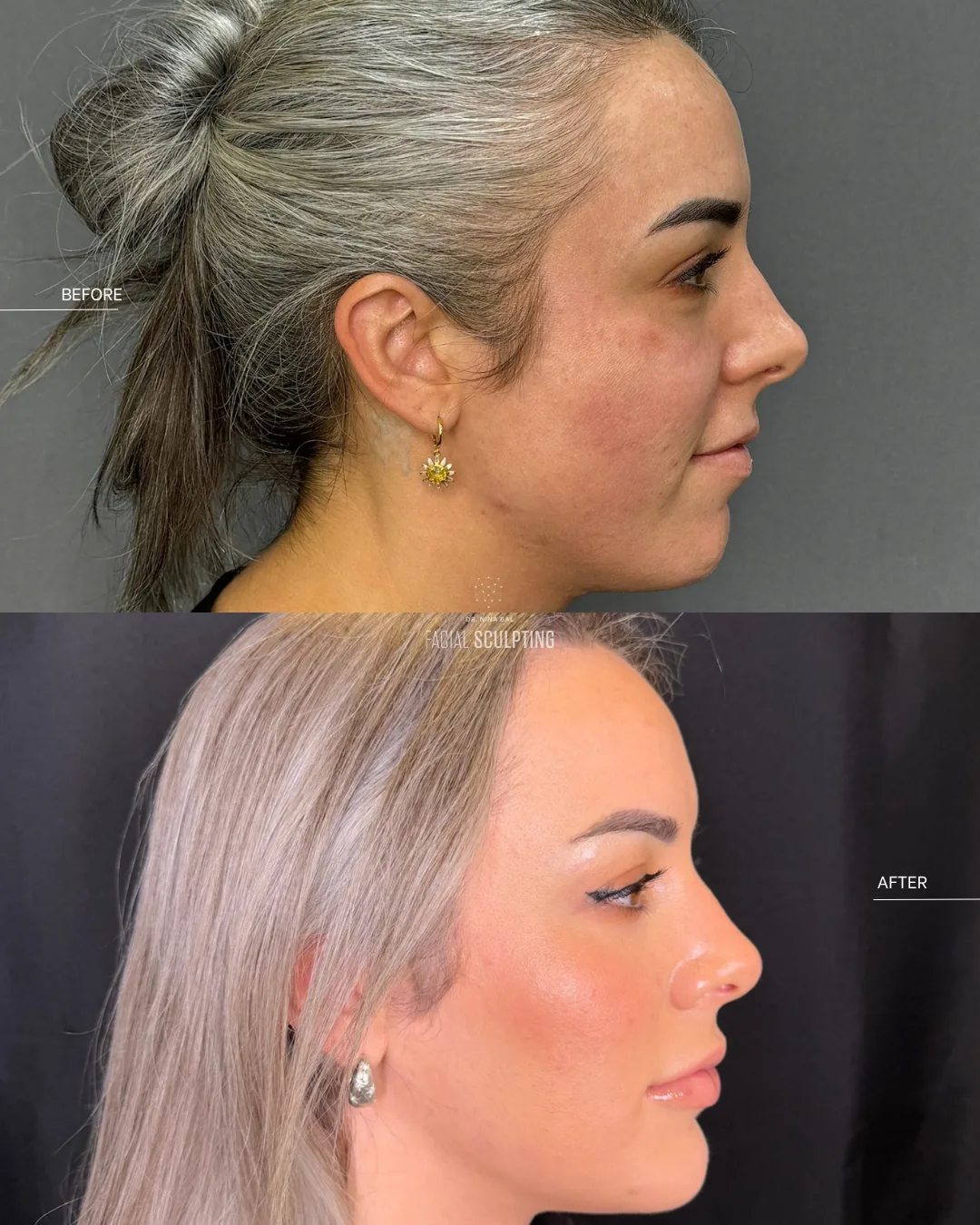
Before & after cheek filler
Real Facial Sculpting patients photographed before and after treatment. Many of the results shown combine Cheek Fillers with complementary treatments in a bespoke plan designed by Dr Nina Bal and her team.
Individual results vary from patient to patient and are not guaranteed. Photographs are of a real patient, shown for illustration, and are not a promise of a specific outcome.
Concerns it can help
What does cheek filler address?
Cheek filler is designed for volume, gentle lift and cheekbone definition in the midface.
Suitability
Is cheek filler right for you?
Cheek filler is not for everyone, and we will tell you if it is not the best option for you. Final suitability is always confirmed at consultation.
Often well suited
- Volume loss or flattening of the midface with age
- Cheeks that look tired, sunken or lack projection
- Wanting subtle cheekbone definition and balance
- Looking to soften, not erase, the nose-to-mouth area
- Realistic expectations of a natural, refreshed result
- Happy for a top-up to fine-tune if needed
May not be suitable
- Significant skin laxity better suited to tightening or surgery
- Active skin infection, cold sore or inflammation in the area
- Pregnancy or breastfeeding (subject to clinic policy)
- A history of severe allergy or certain autoimmune conditions
- Unrealistic expectations or wanting a heavily “done” look
- Body-image concerns that filler is unlikely to resolve
The process
How cheek filler works, step by step
- Consultation & assessmentDr Nina or the team assess your facial anatomy, skin, medical history and goals, and confirm whether cheek filler is suitable or whether another option suits you better.
- Plan & markYour midface is assessed in proportion to the whole face; injection points are planned to restore volume and definition where you have actually lost it.
- ComfortThe skin is cleansed and topical numbing can be applied; most HA fillers also contain local anaesthetic for comfort.
- Precise placementSmall amounts of HA filler are placed with a needle or cannula in the planned points and gently moulded for a smooth, even result.
- Review & aftercareYou see an immediate change, receive aftercare advice and can have a review once any swelling settles, with a top-up only if needed.
“A less-is-more philosophy: cheek filler only when it’s genuinely right for you, to restore and refine, never to over-fill.”
The Facial Sculpting approach · Dr Nina BalBefore treatment
What happens at your consultation
A consultation is recommended before cheek filler. During your initial consultation with Dr Nina and her team you will have a facial-anatomy assessment, your medical history reviewed and your suitability confirmed. You will be talked through the procedure in detail, what to expect during and after, and given the opportunity to ask questions.
The consultation covers your goals, a midface assessment in the context of your whole face, realistic expected outcomes, alternatives if filler is not ideal, the possibility of dissolving with hyalase, aftercare, and confirmation of your individual plan and price.
Results & recovery
What to expect afterwards
Cheek filler involves minimal downtime, and most patients return to normal activities the same day. Swelling is common in the first day or two and a little bruising or tenderness is possible; bruising usually fades within one to two weeks and swelling settles over roughly two to four weeks as the filler integrates. Your team provides tailored aftercare advice.
Results & longevity: the volume change is visible immediately, though the final, settled look is best judged at around two weeks. Cheek filler is not permanent, it is gradually broken down by the body and typically lasts around 12 to 18 months in this area, after which a top-up maintains the result. Duration varies with the product used, your metabolism and lifestyle.
Typical results timeline
Same day
Immediate volume and definition; some swelling is normal and expected.
First 1 to 2 weeks
Any swelling and bruising settle; the result begins to look natural.
~2 weeks
Filler has integrated; this is the point to judge the final result.
~12 to 18 months
Volume gradually fades; a top-up refreshes and maintains the look.
Safety
Possible risks & side effects
As with any dermal filler, cheek filler carries some risks. Common, temporary effects include swelling, bruising, redness, tenderness and small lumps that usually settle as the filler integrates. Less common risks, such as infection, asymmetry, or filler placed unevenly, are reduced by careful technique and discussed individually at consultation.
A rare but serious risk of any facial filler is accidental injection into a blood vessel (vascular occlusion), which is why an experienced, medically trained injector and a clinic stocked with hyalase matter. HA filler is reversible: if you are unhappy with the result, or in the event of a complication, it can be dissolved. If anything is unexpected after treatment, contact the clinic for advice.
Limitations
What cheek filler cannot do
- It adds volume, it cannot tighten significantly loose or excess skin.
- It cannot replace the lift of a surgical procedure for advanced sagging.
- It will not, on its own, remove deep static lines or fully correct a heavy double chin.
- It is temporary, maintenance is needed to keep the result.
Compare your options
Cheek filler vs other approaches
A simple, clear comparison to help you and Dr Nina choose the right route for the midface.
| Approach | Best for | Invasiveness | Downtime |
|---|---|---|---|
| Cheek filler (HA) | Restoring midface volume & cheekbone definition | Minimally invasive injectable | Minimal |
| Face Shape Sculpting | Full-face structure & balance across multiple areas | Minimally invasive injectable plan | Minimal |
| The Golden Ratio | Proportion-led assessment & bespoke sculpting plan | Minimally invasive injectable plan | Minimal |
| Profhilo® | Skin quality, hydration & firmness (not volume) | Non-surgical injectable | Minimal |
| EMFACE® | Tone & a subtle lift without needles | Non-invasive RF + electromagnetic | None |
| Endolift® | Tightening early-to-moderate laxity of the lower face | Minimally invasive laser | Minimal |
Cheek filler is often planned with Profhilo® for skin quality, or as one element of a full-face face shape sculpting plan, the right combination is discussed openly at consultation.
Transparent pricing
How much do cheek fillers cost?
Prices start from £635 per ml, your exact plan is confirmed after consultation.
Cheek Sculpting (1ml)
From£635
One millilitre of hyaluronic-acid filler to restore midface volume and define the cheekbones; quantity confirmed at consultation.
Book this planThe exact price depends on your individual plan, which is confirmed after your consultation. View the full price list.
Why Facial Sculpting
Cheek filler at the Facial Sculpting Clinic
Assessed by Dr Nina
Assessment first. If cheek filler isn’t right for you, we’ll say so and recommend a safer or better option.
Natural, less-is-more
We restore and define rather than over-fill, for a refreshed midface that still looks like you.
Reversible & safe
HA filler can be dissolved with hyalase, and treatment is carried out by a medically trained injector.

Dr Nina Bal
Cosmetic Doctor & Founder · South Kensington, London
Patients choose Facial Sculpting for cheek filler because the focus is on careful facial assessment, natural-looking volume and clear advice, not a one-size-fits-all, over-filled look. Dr Nina and her clinical team plan the midface in proportion to the whole face, and combine cheek filler thoughtfully with treatments such as Profhilo® for skin quality or a full-face face shape sculpting plan where appropriate, rather than treating one area in isolation.
GDC registeredBCAM memberSave Face PlatinumJCCP
TheIndustry.beauty Innovators 2026, Best Aesthetics PracticeGHP Best Facial Transformation Clinic London 2026Endolift UK Achievement Award 2025Safety in Beauty Best Aesthetic DoctorSafety in Beauty Best Non-Surgical TransformationGHP Best Non-Surgical Aesthetics Studio 2024Aesthetics Awards Finalist 2024Save Face Platinum
Accreditations & recognition
 Save Face Platinum accredited
 Registered with the General Dental Council
 British College of Aesthetic Medicine member
 Save Face COVID-19 Operational Protocol Certified
 ICO, Information Commissioner's Office
 JCCP, Joint Council for Cosmetic Practitioners
 Featured in the Tatler Address Book
 Hello! Aesthetics Guide
 Safety in Beauty member
Trusted by patients
What our patients say about Facial Sculpting Clinic
Real reviews from patients who chose Dr Nina Bal and the Facial Sculpting team.
5.0
★★★★★
Rated 5.0 by patients on Google
via Google
A
Áine O.Patient review
★★★★★
Delighted with my results and the fantastic skin- care after plan Dr Nina put together. Dr Nina and her associate are fabulous team
Verified patient
K
Karen B.Patient review
★★★★★
I was introduced to Dr Nina by a friend and I can’t rate her professionalism and work highly enough. Dr Nina put me at my ease from the first moment we met. I was feeling very problemed with my jawline and marionette lines on either side of my mouth Dr Nina prescribed Endolift facial sculpting. Within under one hour of me lying on her couch for the treatment I looked like a new woman. To say that I was exceedingly pleased with the procedure is an understatement. I will definitely be returning for further Endolift work, and actually sharing this fabulous clinician with good friends KB LONDON
Verified patient
M
Mandi V.Patient review
★★★★★
Amazing results! So so happy with my facial profile balancing!
Verified patient
T
Tracey H.Patient review
★★★★★
Dr Nina is an artist! Do not hesitate to book an appointment, you will have an amazing experience. I have been going to Nina for the past 4 years. I have had Botox, fillers, under eye bags removed, most recently had a V Soft Line Thread Lower Face Lift (non surgical procedure). I have never felt any pain with any of my treatments or procedures. Nina is so gentle you don’t feel a thing, always caring, always advises the best solution for your face type and your problem area. Every visit I feel so welcomed, like a real VIP
Verified patient
L
Liz H.Patient review
★★★★★
I have been seeing Dr Nina now for a couple of years and there is nobody else I would trust with my face. I initially saw someone else and had no effect with the anti wrinkle treatments and was told they didn’t work for me. I was really conscious of a deep forehead wrinkle that I had. I then tried Dr Nina and it disappeared after the first treatment. Have been coming back since, always such a pleasant experience.
Verified patient
Your questions
Cheek filler FAQs
What are cheek fillers?
Cheek fillers are a non-surgical treatment in which cross-linked hyaluronic-acid (HA) dermal filler is injected into the midface to restore lost volume and define the cheekbones. HA is a substance the body produces naturally, and the filler gives soft, supportive volume for a more lifted, contoured look.
How much do cheek fillers cost in London?
Cheek filler at Facial Sculpting starts from £635 for 1ml of hyaluronic-acid filler. The exact amount of product depends on your anatomy and goals, which are assessed at consultation, where your individual plan and price are confirmed.
Do cheek fillers hurt?
Most patients find cheek filler very tolerable. The skin can be numbed with a topical anaesthetic, and most HA fillers also contain local anaesthetic, so you typically feel a small scratch and some pressure rather than significant pain. Using a cannula in some areas can further reduce discomfort.
How long do cheek fillers last?
Cheek filler typically lasts around 12 to 18 months, which is often longer than more mobile areas such as the lips because the midface moves less. Longevity varies with the product used, your metabolism and lifestyle, and a top-up maintains the result over time.
Will cheek fillers look natural?
When placed conservatively and in the right anatomical points, cheek filler should look natural, restoring volume you have lost rather than adding an obvious “done” look. Dr Nina works to a less-is-more philosophy and assesses the midface in proportion to your whole face, so the result refreshes rather than changes you.
Can cheek fillers be dissolved?
Yes. Because we use hyaluronic-acid filler, cheek filler can be dissolved with an enzyme called hyaluronidase (hyalase). This means the treatment is reversible, useful if you change your mind, want an adjustment, or in the rare event of a complication. See our hyalase page for more.
How much filler do I need for my cheeks?
Many patients start with around 1ml per side, but the right amount depends on how much volume you have lost and your goals. Dr Nina will recommend a sensible quantity at consultation and would rather start conservatively and refine with a top-up than over-fill in one visit.
Will my cheeks be swollen after filler?
Some swelling is normal in the first day or two and is part of the healing process; it usually settles over roughly two to four weeks as the filler integrates. A little bruising or tenderness is also possible. We give you aftercare advice to help minimise swelling, such as avoiding strenuous exercise for the first day.
How long do cheek fillers take to settle?
You see an immediate change, but the filler continues to settle and integrate over the following two weeks. We recommend judging your final result at around the two-week mark, which is also when any review or top-up is best arranged.
Are cheek fillers safe?
Hyaluronic-acid cheek filler has a long track record when performed by a trained medical injector. The main risks, swelling, bruising and, rarely, vascular complications, are minimised by careful technique, sound anatomical knowledge and a clinic that stocks hyalase. Suitability and risks are discussed in full at your consultation.
Can cheek filler lift my face?
Cheek filler can give a subtle lift by restoring volume and support to the midface, which can also soften the nose-to-mouth area. It is not a substitute for a surgical facelift and cannot tighten significantly loose skin, where there is marked laxity, Dr Nina will discuss tightening treatments or a surgical opinion instead.
What is the difference between cheek filler and a liquid facelift?
Cheek filler treats the midface specifically, while a “liquid facelift” usually refers to a fuller plan of injectables across several areas of the face. At Facial Sculpting that wider, proportion-led approach is offered as face shape sculpting or The Golden Ratio; cheek filler is often one component of it.
When can I wear makeup after cheek filler?
We generally advise leaving the treated area free of makeup for the first 24 hours to keep the tiny injection points clean and reduce the risk of infection. After that you can return to your normal routine, following the specific aftercare given to you.
Can cheek filler help with under-eye hollows?
Restoring midface and cheekbone volume can indirectly support the under-eye area and improve the cheek-to-eye transition. For hollowing and dark circles directly under the eye, however, tear trough rejuvenation is the more specific treatment, and Dr Nina will advise which approach, or combination, suits you.
Is a consultation required before cheek filler?
A consultation is recommended to assess your facial anatomy, skin and medical history, confirm whether cheek filler is suitable or whether another option is better, discuss realistic outcomes and reversibility, and agree your individual plan and price before any treatment.
Take the next step
Book your cheek filler consultation
If you are considering cheek filler, a consultation will confirm whether it is right for your skin, anatomy and goals, and give you a clear recommendation and exact pricing.
Medical disclaimer: This page is for general information about a non-surgical aesthetic treatment and is not medical advice. Suitability, benefits, risks and results vary from patient to patient. Dr Nina Bal and her team will assess whether cheek filler is appropriate for you during a consultation. Before-and-after photographs are of individual patients for illustration only and are not a guarantee of any specific outcome.