


Journal · Facial Sculpting
Why Is My Face Wonky? Causes and What Helps

Your face looks wonky because almost no face is symmetrical. The two sides grow slightly differently, the muscles on each side pull with different strength and habit, volume is lost unevenly as the face ages, and the bone and bite underneath are rarely a matched pair. Some of that is treatable, some of it is structural, and a good deal of it is simply normal and better left alone. Which applies to you decides what, if anything, is worth doing.
This guide sets out what actually drives an uneven face, how to tell a real difference from one a photograph invented, which categories respond to non-surgical treatment and which do not, and the signs that mean a doctor rather than a clinic. The treatment detail and suitability sit on our facial asymmetry concern page. This is general information rather than personal advice.
Key takeaways
- Minor left to right difference is the norm, not a fault, and perfect symmetry tends to look artificial.
- Four things drive it: development, muscle pull and habit, uneven volume loss with age, and the underlying bone and bite.
- Soft tissue and muscle differences are the most treatable. Skeletal and dental ones are not, and filler over them rarely helps.
- A mirror and a phone camera both distort the picture, so judge by what other people notice in real life.
- Unevenness that comes on suddenly is a medical emergency, not a cosmetic question.
What makes one side of the face different to the other?
Four separate things, usually stacked on top of one another. Separating them is the whole point of an assessment, because each one has a different answer.
Development. The left and right halves of the face grow as two halves, and they finish at slightly different sizes and positions. One eye socket may sit marginally higher, one side of the jaw may be a shade longer, one nostril a different shape. This is the version of unevenness that has simply always been there, and it is the one most people are looking at when they first notice it.
Muscle pull and habit. The muscles of facial expression do not work as a matched pair. A dominant side raises a brow further, pulls a smile wider, or creases earlier, and decades of the same expression make the difference progressively easier to see at rest. Sleeping position and chewing mostly on one side belong in this group too: they are often raised in consultation, and while they are rarely the main driver on their own, they are part of how a face settles over many years.
Uneven ageing. Volume is not lost symmetrically. One cheek can flatten before the other, one brow can descend further, and the skin on one side of the jawline can soften first. A face that looked level at twenty five can look lopsided at forty five without anything having gone wrong, because the two sides are simply ageing at their own pace.
Bone, bite and teeth. Underneath all of it is a skeleton and a set of teeth, and those are structural. A deviated chin, a jaw that sits further forward on one side, a crossbite or long standing orthodontic difference will push the soft tissue around it out of line. Nothing injected into the surface changes the shape of the bone beneath it.
The useful question is never how uneven am I. It is what is driving the difference, because the cause decides whether anything can sensibly be done about it.
Is my face really wonky, or is it the photograph?
Often both. There is almost always a real difference to find, and then the picture exaggerates it. A mirror shows you a left to right reversed face, and that reversed version is the one you have looked at every day of your life. A photograph shows the unreversed face everyone else sees, so a small difference lands on the side you are not used to and reads as new. Holding a phone at arm's length makes whatever is nearest the lens look proportionally larger, side lighting deepens one half, and a single frame freezes one moment of a moving face.
The reliable test is whether people who are not studying a photograph notice the difference in ordinary life. If the answer is no, you are probably looking at normal variation amplified by the picture. We have set out exactly what the camera changes, and how to take a photograph that shows your face accurately, in a separate piece on why faces look uneven in photographs but not in the mirror.
Which causes respond to treatment, and which do not?
This is where the categories above earn their keep, because they sort neatly into what is worth assessing and what should be referred.
| What is driving it | How it tends to look | What is realistic |
|---|---|---|
| Soft tissue and volume | A flatter cheek, a lower brow or an uneven lip line on one side | The most treatable group. A considered balancing plan can soften a difference that genuinely draws the eye. |
| Muscle and movement | One brow raised higher, a smile that pulls to one side | Minor differences often respond to carefully dosed, side specific botulinum toxin. Pronounced or anatomy driven ones may only partly improve. |
| Skeletal and dental | A deviated chin, an uneven jaw, a bite that does not meet evenly | Beyond non-surgical aesthetics. A surgical or dental opinion is the appropriate route. |
| Nerve or muscle condition | Drooping, weakness or altered movement on one side | A medical question first. Any aesthetic work comes afterwards and alongside the medical team. |
Where the difference is soft tissue or muscle, the treatments are the ordinary balancing ones. Uneven brows can often be evened out with a brow lift, which relaxes the brow depressor muscles with different doses on each side. A chin that looks off centre or under projected can sometimes be improved with chin sculpting, and broader proportion with face shape sculpting. When several areas are involved, Dr Nina's Asymmetrical Face protocol is an assessment and a bespoke plan rather than a single procedure, and the closely related Golden Ratio analysis is used where the concern is overall proportion rather than one uneven feature. Where the imbalance is mostly in the profile, that is covered under side profile and chin projection.
The limit is worth stating plainly, because it is the part clinics tend to leave out. The aim is to soften a noticeable difference, not to deliver a mirror image face, and there are faces where the right recommendation is no treatment at all. That is the same facial balancing logic applied to one specific worry: change the relationship pulling the face out of proportion, and protect everything that is already working.
A considered next step
Want to know whether what you are seeing is treatable, or simply normal?
A consultation with Dr Nina begins by reading your face at rest and in movement, in person rather than in a photograph. If the right answer is that nothing needs treating, that is what you will hear.
When does an uneven face need a doctor rather than a clinic?
There is one situation where nothing above applies. Unevenness that appears suddenly is a medical matter and needs urgent attention. Seek emergency help by calling 999 in the UK if one side of the face droops or your smile changes abruptly, particularly alongside weakness or numbness in an arm, difficulty speaking, confusion or a change in vision. Sudden facial weakness can also occur in Bell's palsy, which is not an emergency in the same way but should still be seen by a doctor promptly, because early treatment matters. Once the diagnosis is established and the acute phase has passed, residual unevenness after Bell's palsy is something the clinic does treat, working alongside your medical team rather than instead of it.
New unevenness that develops over weeks or months, or that comes with pain, swelling, hearing changes or difficulty chewing, also belongs with your GP first. Facial Sculpting does treat some medically driven facial asymmetry, but only after the underlying cause has been established by the right specialist.
What happens if you come in and ask about it?
The first appointment is a reading of the face rather than a treatment. Dr Nina studies it straight on and in profile, at rest and in movement, because a difference that only appears when you smile is a different problem to one that is there when your face is still. The point is to sort what you are seeing into the categories above, then to say which parts are treatable, which are normal and better left alone, and which belong with a surgeon, a dentist or your GP.
Patients are often surprised by how much of the appointment is spent on what will not be treated. That is deliberate. Unevenness is easy to over treat, and a face that has been corrected feature by feature towards symmetry usually ends up looking less like itself rather than more balanced.
Most common cause
Normal developmental difference, with uneven muscle pull and uneven volume loss layered on top of it.
What is realistic
Softening a genuinely noticeable soft tissue or muscle difference. Never a perfectly symmetrical face.
When to seek help urgently
Any sudden facial droop, weakness, speech or vision change. Call 999 in the UK.
If you have been studying the same side of your face in the mirror for months, an in-person assessment will tell you more in twenty minutes than the mirror ever will. Book a consultation at our South Kensington clinic or message us on WhatsApp, and you will get a straight answer about what is driving the difference and whether anything is worth treating.
Common questions
Your questions, answered
-
Because almost nobody has a symmetrical face. The two sides develop slightly differently, the muscles on each side pull with different strength and habit, volume is lost unevenly as the face ages, and the underlying bone and bite are rarely identical left to right. Any one of those can leave a brow, cheek, lip line or chin sitting differently to its opposite number. A degree of unevenness is normal and is part of what makes a face look like a face rather than a diagram.
-
Yes. Minor left to right difference is so common that a perfectly matched face tends to look artificial. Most people have one brow a little higher, one cheek slightly fuller, or a smile that pulls more to one side. Unevenness is worth looking at when it is noticeable to other people under ordinary conditions, has been stable for a long time, and bothers you enough to want an answer.
-
Sleeping position and chewing mostly on one side are often raised in consultation, and they sit in the same category as other long-term habits: they may contribute to how one side looks over many years, but they are rarely the main driver on their own. Development, muscle pull and the uneven way volume is lost with age usually account for more of what you are seeing.
-
No, and that is not the aim. Perfect symmetry does not occur in nature and tends to look unsettling when it is manufactured. What careful treatment can do, where the difference is driven by soft tissue or muscle, is soften an imbalance that genuinely draws the eye while keeping the face recognisably yours. Unevenness coming from the bone, the bite or a nerve condition sits outside non-surgical aesthetics.
-
Any unevenness that appears suddenly, or that comes with drooping on one side, a changed smile, weakness, numbness, difficulty speaking or a change in vision, needs urgent medical assessment rather than an aesthetic consultation. In the UK that means calling 999 if it comes on suddenly. New unevenness that develops over weeks or months, or that comes with pain, swelling, hearing change or difficulty chewing, belongs with your GP first.
-
It depends entirely on the cause, which is why assessment comes first. Uneven brows can often be rebalanced with carefully dosed, side specific botulinum toxin in a brow lift. An off centre or under projected chin can sometimes be improved with chin sculpting. Where several areas are involved, the Asymmetrical Face protocol is an assessment and a bespoke plan rather than one procedure. Skeletal, dental and nerve related differences are referred.
Keep reading
Related reading
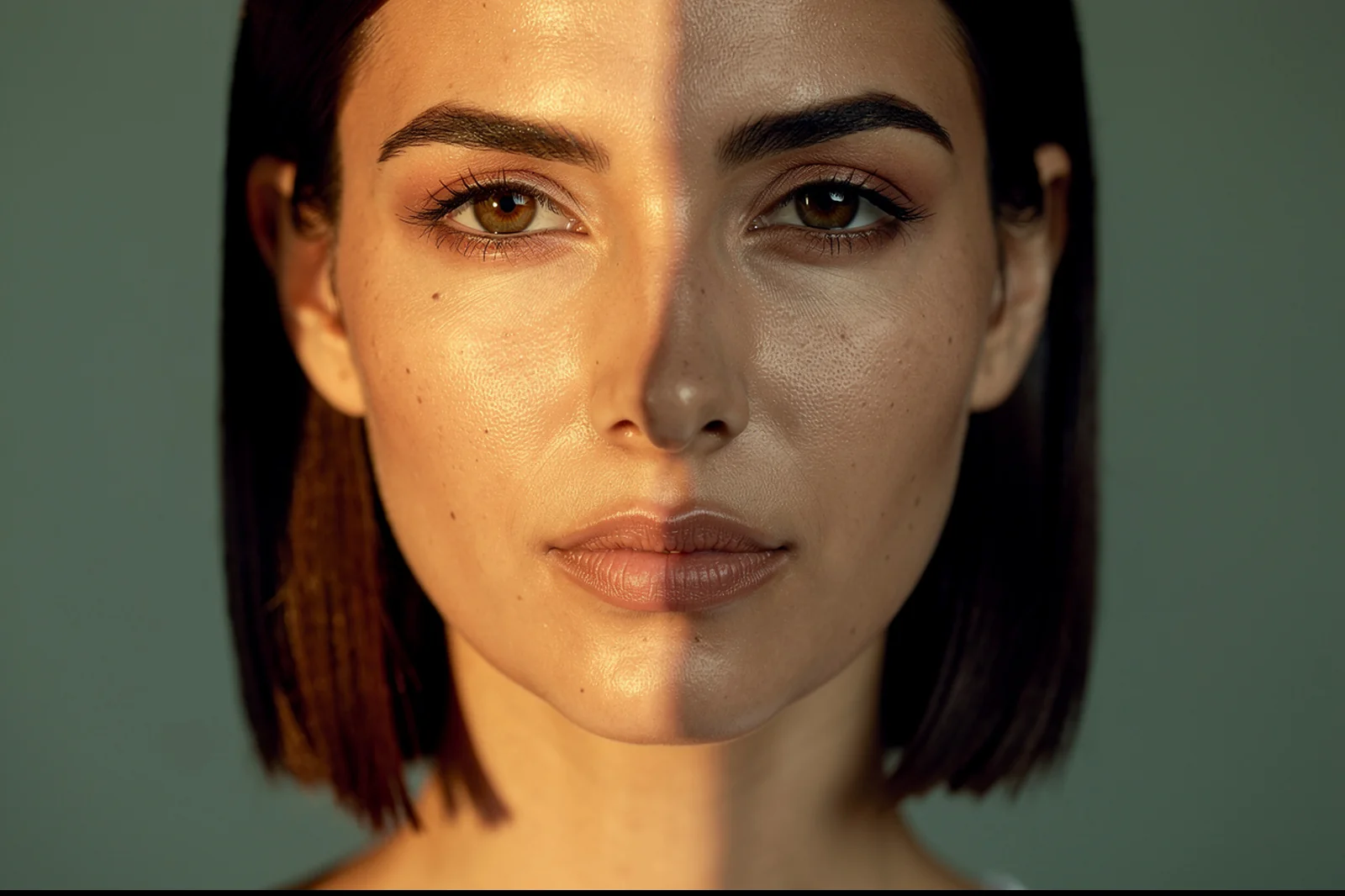
Why Your Face Looks Asymmetrical in Photos but Not in the Mirror
Why a photo makes your face look uneven when the mirror does not, what the camera changes, and when facial asymmetry is worth assessing. Dr Nina Bal, London.
Read more
What Is Facial Balancing? A Guide to Harmonising Your Features
What facial balancing actually means, how a proper assessment works, which treatments are used and when each is wrong, explained by Dr Nina Bal in London.
Read more
Side Profile and Chin Projection: What Causes It and Which Treatments Help
Why a profile looks unbalanced, why a weak chin makes a nose look larger, what chin filler can and cannot change, and when the right answer is surgery. London.
Read more